Male dog rallies with investigational medication
A case managed by Companion Animal Internal Medicine specialists at The Ohio State University Veterinary Medical Center (VMC) shows how investigating proven therapies in humans may advance ways to address complex health conditions in animals.
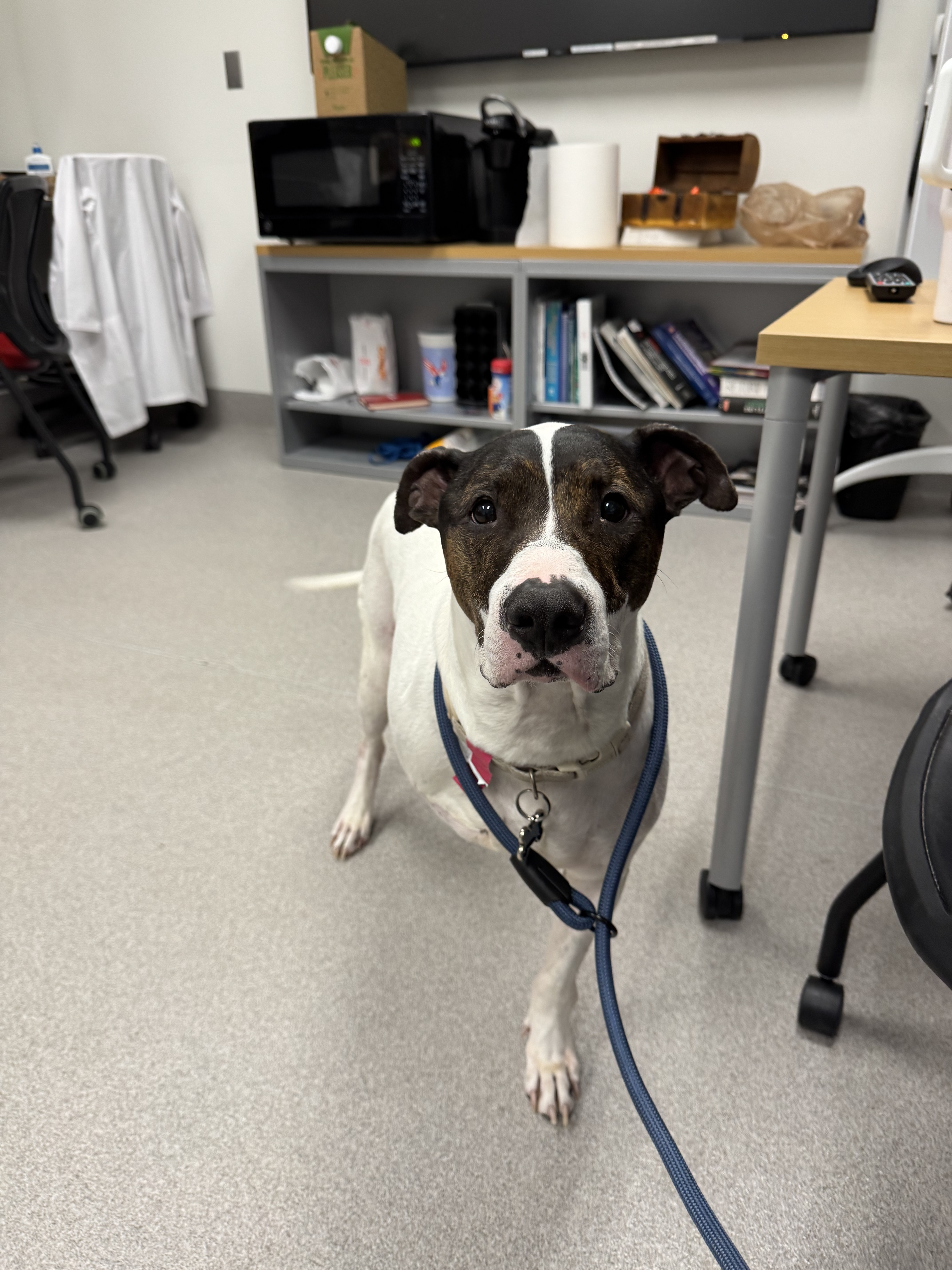
Such was the case with Finn Lambert, a five-year-old male mixed-breed who was referred to the VMC in September 2024 after his primary care veterinarian, Aaron Buck, DVM, discovered he had no platelets after being vaccinated. When his owners, Katie Lambert and JC Mautino arrived with Finn, he had a patch of bruising under his right forearm and pinpoint gum bleeding, a sign of the body’s inability to clot blood.
The Companion Animal Internal Medicine service team, including Jessica Quimby, DVM, PhD, DACVIM (SAIM) clinical professor and vice chair of Research in Clinical Sciences, and third-year resident John Rowe, DVM, MS evaluated Finn and confirmed the diagnosis of immune-mediated thrombocytopenia as Finn had no platelets in his blood to form clots.
During his five-day hospital stay at the VMC, Finn responded well to initial treatment of multiple medications, including steroids, to suppress his immune system as well as a chemotherapy agent, vincristine. Finn went home, but relapsed a month later, returning in November 2024 to the VMC, where he stayed for four days. The team adjusted his medications and again he went home having a positive response to these adjustments.
During Finn’s second hospitalization, the team discussed reevaluating their approach beyond the steroid therapy, says Dr. Rowe, who with Molly Bechtold, DVM, DACVIM (SAIM), assistant professor – clinical, discussed with Katie the possible use of Romipolostim (brand name Nplate), which directs the body’s bone marrow to create platelets. The only other option was for Finn to have his spleen removed, an invasive procedure requiring extensive recovery time.
First documented in 2016 to be used in dogs lacking platelets, Nplate has been used in humans as an FDA approved therapy since 2008. The treatment is administered by injection under the skin and has shown great promise in people, Dr. Rowe says, including standard use of the therapy in some clinical situations.
In January 2025, Finn returned to the VMC after yet another relapse, and in agreement with Katie, and in consultation with VMC pharmacist Rikki Horne, PHARMD, FSVHP, DICVP, the team gave Finn the Nplate injection.
In humans, the medication is given regularly every week or every other week, Dr. Rowe says, “but there's some evidence in dogs that single injections might get them over this hump of a relapse and be able to then help control their disease process.”
In the more than nine months since Finn received the treatment, he has been able to be on less medication, no longer requires steroid medication and has a normal platelet count living a normal life at home, says Dr. Rowe. “One of the big goals with these patients is to get them off of needing to be on a steroid medication for the rest of their life.”
The treatment was so successful that Finn was able to successfully undergo a dental procedure at his primary care clinic within the first 10 days after he received the Nplate.
Finn remains on just a single, oral medication, leflunomide, which decreases inflammation by the immune system and controls Finn’s autoimmune disease. “In the long term, that’s going to be a much better situation for him than needing to be on steroids for the rest of his life as a five-year-old dog,” Dr. Rowe adds.
He notes that to his knowledge, no veterinary hospital in the United States has used this medication before that is published in the existing veterinary literature.
Dr. Rowe encourages primary care veterinarians to reach out to the VMC’s Companion Animal Internal Medicine team for a consult or any questions they might have about a patient, especially ones with immune-mediated diseases that require life-long ongoing care.
For Katie, having Finn “back to his normal self” is thrilling. “He's happy and energetic,” she says.
“He lost a lot of weight from the being on the high dose steroids for so long, but he's gained most of his weight back. We couldn’t be more grateful to Dr. Rowe and to the team at Ohio State.”